Figma Make Is a Sign That Marketing Execution Is Getting Faster — But Strategy Still Wins
Figma Make is one of those launches that should make marketers pay attention.
Not because it replaces designers. Not because it magically builds a growth engine. Not because every company suddenly needs to rebuild its website.
It matters because it points to a bigger shift happening across the industry:
The distance between an idea and a working digital experience is getting much shorter.
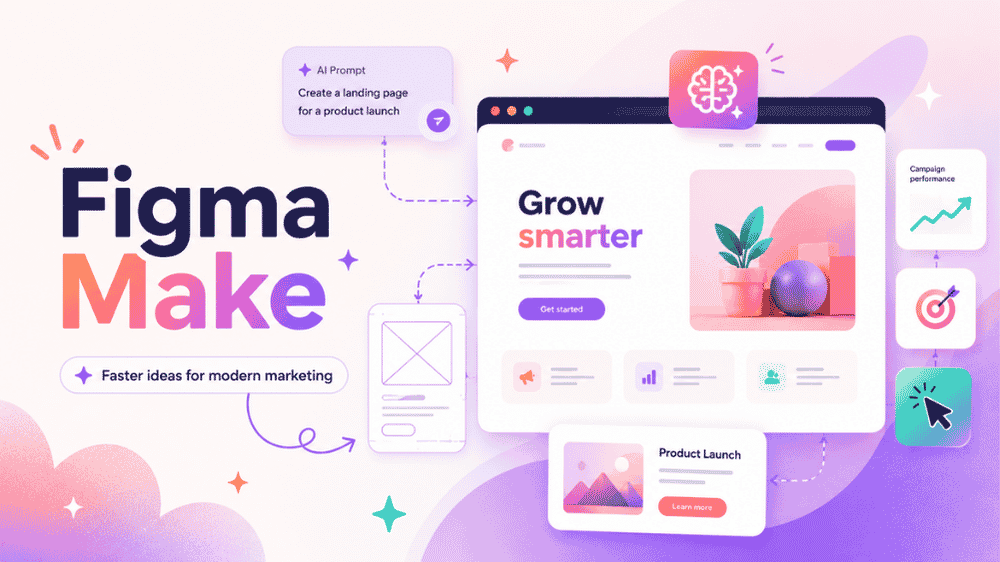
Figma Make lets teams use prompts, designs, and existing brand context to create interactive prototypes and app-like experiences faster than traditional workflows. For product teams, that is exciting. But for marketing teams, it may be even more important.
Marketing has always lived in the gap between idea and execution.
You have a campaign idea. You need a landing page. You need a demo flow. You need a sales asset. You need a product explainer. You need something interactive enough to help people understand the offer.
Then everything slows down.
Copy waits on strategy. Design waits on copy. Development waits on design. Sales waits on marketing. Leadership waits on results.
Tools like Figma Make are attacking that bottleneck.
But faster execution does not automatically mean better marketing. It just exposes whether your strategy is clear enough to move quickly.
What Figma Make Means for Marketers
At a basic level, Figma Make helps teams turn ideas into interactive prototypes using AI. You can start with a design, prompt changes, explore flows, refine copy, adjust layouts, and create something people can actually click through.
That changes the marketing workflow. Instead of spending weeks debating what a campaign, page, or product concept might look like, teams can create rough versions quickly and use them to make better decisions.
A marketing team could use Figma Make to prototype:
- Landing page concepts
- Campaign destinations
- Product demo flows
- Interactive sales assets
- Onboarding experiences
- Offer concepts
- Website sections
- Lead-generation tools
- Calculators, quizzes, or guided experiences
- That does not mean every prototype should become a finished product. In fact, the biggest value may be the opposite.
- Figma Make can help teams learn what is worth building before they spend too much time or money building it.
The Real Opportunity Is Faster Learning
The best use of Figma Make is not simply, “Build me a landing page.”
The better use is:
“Help us test this idea faster.”
That is where marketing teams should get excited.
Imagine you are considering three new offers. Instead of debating them in a document, you can prototype three simple landing pages or demo flows. Then you can review them with sales, test the messaging, share them with prospects, or use them to sharpen the campaign strategy.
You can find out:
- Which offer is easiest to explain?
- Which message creates the most interest?
- Which audience understands the value fastest?
- Which CTA feels natural?
- Which objections show up early?
- Which concept deserves a real campaign?
- That is the real promise.
- Not more output. Better feedback.
- And better feedback is what helps teams make smarter marketing decisions.
The Risk: More Stuff, Not More Revenue
There is also a real risk here.
AI tools make it easier to create more pages, more assets, more campaign ideas, and more prototypes. But more output does not always mean more progress.
If your positioning is unclear, Figma Make can help you create unclear pages faster. If your ICP is fuzzy, it can help you generate generic campaigns faster. If your sales process is disconnected from marketing, it can create more assets that no one knows how to use. If your analytics are weak, you may create more tests without knowing what worked.
This is where many teams will get stuck. They will move faster, but not necessarily in the right direction.
The companies that win with tools like Figma Make will not be the ones that generate the most assets. They will be the ones that connect faster creation to a stronger go-to-market system.
Every prototype, page, and campaign still needs a clear job.
- Who is this for?
- What problem are we solving?
- What offer are we testing?
- What action do we want someone to take?
- How will sales follow up?
- What will we measure?
- What happens if it works?
- Without those answers, AI just creates more motion.
What This Means for Agencies and Internal Teams
Figma Make is another signal that the old marketing production model is changing.
Clients and CEOs will expect faster iteration. Designers will work closer to product and code. Marketers will be expected to prototype ideas, not just brief them. Revenue leaders will want clearer proof before investing heavily in campaigns.
That creates pressure for teams that only know how to produce assets. But it creates opportunity for teams that can connect strategy, execution, and revenue.
Because the future of marketing is not just about making more things faster.
It is about building better learning loops.
That means connecting:
- Market clarity
- Messaging
- Website strategy
- SEO
- Campaigns
- CRM
- Automation
- Analytics
- Sales follow-up
- Revenue reporting
- When those pieces work together, tools like Figma Make become powerful. They help teams test ideas, improve campaigns, and move faster with purpose.
- Without that system, they are just another shiny tool.
The Bottom Line
Figma Make is not just a design tool update. It is part of a larger shift toward AI-assisted execution and faster product-building workflows.
For marketers, that is exciting. But it also raises the bar.
When execution gets easier, strategy matters more.
If your positioning is strong, your audience is clear, and your revenue system is connected, tools like Figma Make can help you move faster and learn faster.
If those pieces are missing, the tool will not fix the problem. It will simply help you create more disconnected work.
At All Great Things, this is the work we care about: helping businesses connect strategy, content, websites, automation, analytics, and sales into one system that actually supports growth.
Because the future of marketing is not just making more things.
It is making the right things, testing them faster, and turning what you learn into revenue.
If your team is experimenting with AI tools, rebuilding your website, launching new offers, or trying to turn marketing activity into real pipeline, let’s talk.
Need More Than Another AI Tool?
Figma Make can help teams move faster. But speed only matters when your GTM system knows where it is going.
All Great Things helps B2B teams connect market clarity, content, SEO, automation, analytics, outbound, and revenue leadership into one operating system.