
GTM attribution breaks before anyone picks first-touch, last-touch, or a multi-touch model. It breaks in definitions, CRM hygiene, and incentives. The model is usually the last thing that fails.
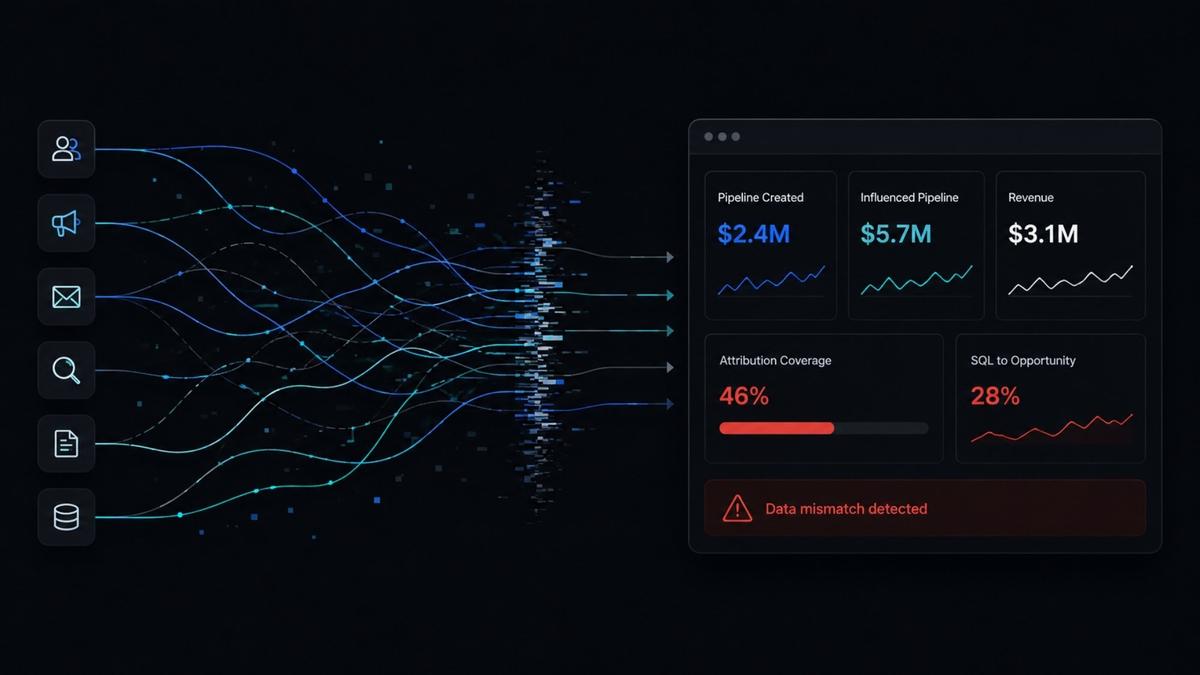
If marketing claims a campaign created pipeline and sales says those deals would have closed anyway, you do not have an attribution-software problem yet. You have two teams reading different objects as if they were the same number.
That is the meeting Jason gets pulled into as an embedded RevOps operator, and the one Jennifer hears at the board: three reports, three truths, and a request for a better model.
The dashboard everyone argues about
Every function wants a dashboard. Each function wants a different answer from it.
Marketing wants channel, campaign, and content influence. Sales wants which opportunities are real, which accounts are moving, and which leads are worth time. Leadership wants what is actually driving revenue.
Force those questions into one view without shared definitions and the dashboard stops being an operating object. It becomes a brief for whoever is presenting this week.
Attribution is becoming a governance standard
In mid-August 2026, coverage of Demand Gen Report's benchmark survey treated revenue attribution as a cross-system data standard, not a marketing analytics project. Once a company claims sourced revenue in an executive forum, the number inherits the same requirements as any financial-adjacent KPI: defined terms, repeatable capture, and an audit trail across CRM, marketing automation, and finance.
That shift matters for operators. Definition drift is the hidden cost. A sourced-revenue rule that worked last quarter breaks when territory models change, partner motions expand, or lifecycle stages get renamed without a migration plan. Multi-touch models do not fix that. They multiply the places drift can hide.
RevOps and finance need a short governance page: who can change a UTM dictionary entry, who approves a lifecycle stage rename, and what gets logged when campaign membership rules change. Without that, year-over-year charts become fiction even when the dashboard looks polished.
Definitions break before the model
Ask five people in the same company to define a marketing-qualified lead. You will often get five answers. The same drift shows up on pipeline, influenced revenue, opportunity-created date, sales-accepted lead, and the attribution window.
Attribution is accounting. You cannot close the books if revenue means one thing in Salesforce and another in the ad platform. No model repairs that.
Write the operating language down. Who owns the field. When the stage can move backward. What sourced versus influenced means in this company, not in a vendor demo.
Failure mode: broken data plumbing
This is where most stacks fail first.
CRM data does not match marketing data
HubSpot says organic search. Salesforce says partner referral. The dashboard now has two origins for one person. Until someone owns the write path, every model just picks a side.
Lead-to-account matching gaps
Orphaned leads and contacts that never roll up to the right account hierarchy break multi-touch logic quietly. Campaign membership on one record does not attach to the opportunity finance recognizes. Hygiene work here is not a quarterly cleanup project. It is weekly spot checks on linkage, role capture, and opportunity contact roles before attribution reviews use the data.
Lifecycle stages are not maintained
A record becomes an MQL, then a customer, then a lead again because a workflow fired on the wrong property. Reporting follows the mess.
Manual gaps
Opportunity fields stay blank. Campaign names drift. Forms write into the wrong object. Software cannot attribute what nobody recorded.
Failure mode: incentive design
Many attribution fights are compensation fights. Marketing wants sourced credit. Sales wants the close. Customer success wants expansion. Partners want influence.
If the number on the slide changes someone's quota or bonus, the report will be designed for visibility. Sourced versus influenced becomes politics. A usable GTM system prefers decisions over departmental credit. That is a leadership problem as much as a RevOps one.
Failure mode: reporting theater
Reporting theater is a dashboard that looks complete and does not change a weekly action. Fifty metrics. A model nobody can explain. Filters that only the analyst uses.
Good dashboards answer a question in the room. Better ones change next week's work. Anything else is decoration.
If the page is a file you rebuild for the meeting, you do not have a dashboard. You have a deck. A living GTM operations system is the opposite: one object that stays current so the meeting can decide.
What a trustworthy GTM dashboard measures
Most teams track too much and share too little language. Keep the view short and connected to revenue.
Marketing: qualified volume, pipeline created, pipeline influenced, cost per opportunity, conversion by stage.
Sales: opportunity creation, win rate, cycle time, pipeline velocity.
Leadership: revenue growth, forecast accuracy, acquisition efficiency, retention.
If a metric does not change a decision, it does not belong on the operating view. Put it in an appendix.
The minimum stack before more software
Most companies do not need another attribution platform. They need ownership.
- Clean CRM: named owners for lifecycle, opportunity fields, and accounts.
- Campaign tracking: UTMs and names that a human can audit.
- Shared definitions: a short page, not a forty-slide framework deck.
- Revenue alignment: marketing, sales, and the board using the same words.
- Change log: dated entries when UTMs, models, or stage definitions shift, with author and reason.
Only after that is it worth evaluating another model or tool. Buying the tool first just automates the argument.
Weekly, monthly, and quarterly cadence
Attribution stays trustworthy when hygiene runs on a schedule, not when someone notices a bad quarter.
Weekly: creation, conversion, campaign movement, sales activity. Reps update next steps and activity logs. RevOps spot-checks form-to-CRM flows and broken UTM captures before the operating review.
Monthly: velocity, forecast error, channel mix, efficiency. Dedupe passes, stale-deal archiving, and enrichment on the records attribution depends on. Reconcile marketing automation dashboards to warehouse or BI views if finance uses a different source of truth.
Quarterly: the model, lifecycle rules, CRM governance, and whether the GTM process still matches how you sell. Full field audit, win/loss review, and whether sourced versus influenced definitions still match the motions you run.
Teams that only review dashboards never fix the system underneath them. The quarterly review is where you change the rules, not the colors. For meeting design and handoffs, see the RevOps playbook operators can actually run.
Directional vs decision-grade measurement
The same discipline applies outside classic CRM attribution. When leadership asks how often AI systems mention the company, vendor scores only help if everyone agrees what counts as directional signal versus decision-grade evidence. Industry guidance published in early August 2026 drew that line explicitly: small prompt sets are useful for trend monitoring, not for budget allocation.
Operators should treat AI visibility checks the same way they treat attribution: define the question, set a stable query set, document methodology changes, and connect downstream signals (referral traffic, branded search, pipeline influence) before the board treats a vendor score as revenue proof. That is search infrastructure work, not a one-time audit.
FAQ
What is B2B marketing attribution?
It is how you assign credit to the work that created or moved pipeline and revenue. It only works if the objects you credit are defined the same way in every system that writes them.
Why don't sales and marketing trust the same dashboard?
Usually inconsistent definitions, dirty CRM data, different report logic, and incentives that reward different versions of the same deal.
What breaks before a multi-touch attribution model?
Data quality, lifecycle governance, campaign tracking, CRM process, lead-to-account matching, and the words you use for pipeline. The model is downstream of those.
When is attribution data defensible enough for the board?
When sourced and influenced definitions are written, owned, and versioned. When opportunities have associated contacts, source fields, and stage timestamps. When marketing and finance reconcile to the same objects on a regular cadence. Until then, treat channel reports as directional, not as quota inputs.
If your team is spending the hour debating the report, the next move is not another platform. It is an operator seat on the plumbing, or a production retainer on the attribution layer, until the room trusts one story. That is the work Jason embeds for. When the same fight is showing up at the board, pair it with Jennifer's commercial leadership work.