AI SDRs Are Not the Strategy: Why Outbound Still Needs Better Targeting, Timing, and Judgment
Searches for terms like AI SDR agent, what is an AI SDR, and AI SDR tools have exploded over the last year.
If you spend five minutes on LinkedIn, you’ll see founders claiming they’ve replaced entire sales teams with AI agents. Venture-backed startups are promising autonomous pipeline generation. Every week seems to bring another tool that says it can find prospects, write emails, follow up automatically, and book meetings without human involvement.
The pitch is seductive:
“Just connect your CRM and let the AI SDR handle outbound.”
The reality is more complicated.
Most outbound programs aren’t failing because humans are sending the emails. They’re failing because companies are targeting the wrong people, reaching out at the wrong time, and using the wrong message.
AI can automate activity.
It cannot automate strategy.
And that’s where many teams are getting it wrong.
Why AI SDR Searches Are Surging (And Why Skepticism Is Healthy)
The excitement around AI SDRs makes sense.
Traditional outbound has become harder.
Open rates are less reliable than ever. Buyers receive dozens of cold emails per day. LinkedIn inboxes are flooded. Generic personalization has become painfully obvious.
At the same time, AI tools have become remarkably good at:
- Researching prospects
- Writing first drafts
- Generating outreach sequences
- Summarizing company data
- Updating CRM records
- Triggering workflows
The result is a new category of software claiming to automate sales development.
But skepticism is healthy.
Many companies buying AI SDR platforms are hoping technology will solve problems that actually stem from poor go-to-market strategy.
An AI SDR cannot fix:
- A weak ICP definition
- Bad data
- Poor market positioning
- Low product-market fit
- Generic messaging
- Mistimed outreach
Those problems existed before AI and they still exist now.
What Is an AI SDR?
At its core, an AI SDR is software designed to automate some of the tasks traditionally handled by a Sales Development Representative.
Depending on the platform, an AI SDR may:
- Build prospect lists
- Enrich contact data
- Generate email sequences
- Personalize outreach
- Send follow-up messages
- Schedule meetings
- Update CRM records
Some vendors market these systems as fully autonomous agents.
In reality, most AI SDR tools are workflow engines wrapped around language models and sales automation software.
That’s not a criticism.
Many of them are genuinely useful.
The mistake is assuming that automation equals strategy.
The Three Things No AI Agent Replaces
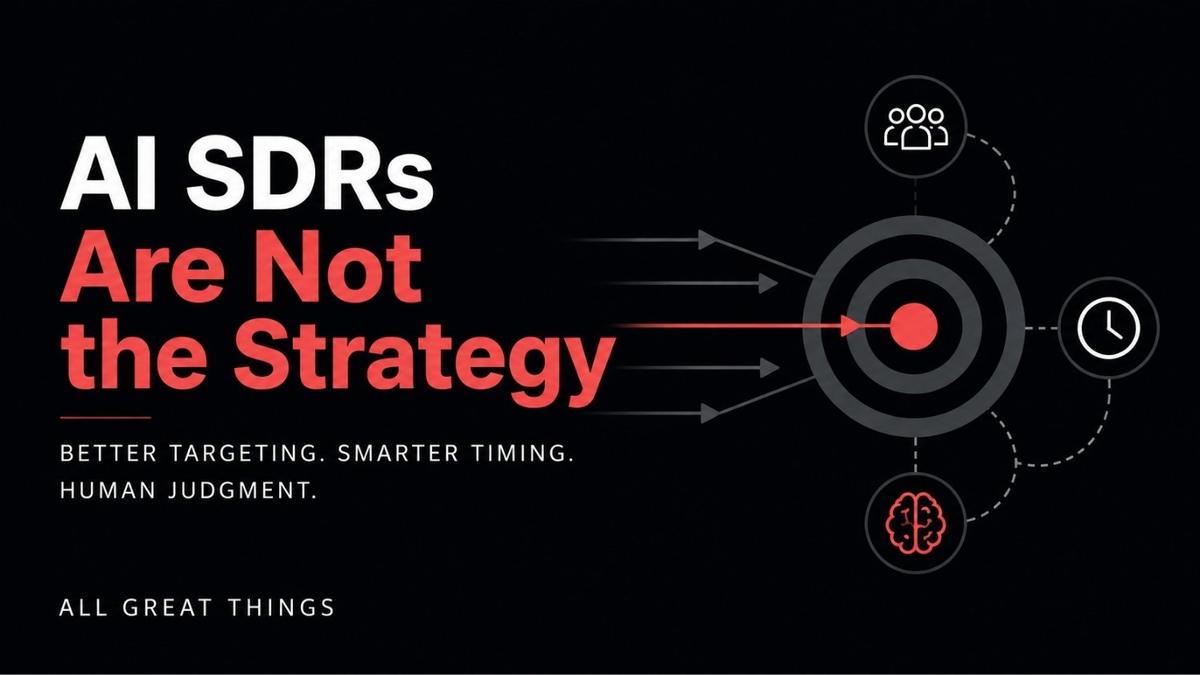
1. Targeting
Most outbound failures start here.
Companies often define their target audience far too broadly.
Instead of identifying the specific accounts most likely to buy, they create giant prospect lists and hope volume creates results.
AI makes this worse because it lowers the cost of sending more messages.
But sending more bad messages isn’t progress.
The best outbound teams spend enormous amounts of time answering questions like:
- Which industries are showing buying intent?
- Which companies fit our ICP today?
- Which segments convert fastest?
- Which triggers indicate readiness?
No AI model knows your market better than you do.
It can help process information.
It cannot decide who matters most.
2. Timing
The difference between a great outbound campaign and a terrible one is often timing.
A prospect may ignore your email today and become a customer three months later.
Why?
Because timing changed.
The best outbound programs are built around signals, including:
- Hiring activity
- Funding announcements
- Leadership changes
- Product launches
- Technology adoption
- Regulatory changes
- Expansion efforts
These signals indicate that a business may actually need what you’re selling.
AI can monitor signals.
It can surface opportunities.
But your go-to-market strategy determines which signals matter.
3. Judgment
This is where AI still struggles.
Judgment is understanding:
- When not to send an email
- When a prospect needs a phone call
- When a deal should be nurtured
- When an account deserves executive attention
- When messaging needs to change
The highest-performing sales organizations don’t win because they automate more.
They win because they make better decisions.
AI helps create leverage.
Humans provide judgment.
Signal-Based Prospecting vs. Automation Theater
Many outbound programs today are performing what I’d call automation theater.
The workflow looks impressive:
- AI writes emails
- AI personalizes copy
- AI sends sequences
- AI follows up
- AI books meetings
Everything appears sophisticated.
But underneath the automation is the same flawed strategy.
The targeting is weak.
The message is generic.
The timing is random.
Signal-based prospecting takes a different approach.
Instead of asking:
“Who can we email?”
The question becomes:
“Who is most likely to need us right now?”
That’s a fundamentally different mindset.
And it’s where modern outbound actually starts producing results.
Where AI Agents Belong in the Outbound Stack
AI is incredibly valuable when deployed correctly.
The strongest implementations we’ve built use AI as a workflow component rather than a replacement for strategy.
Examples include:
Research Acceleration
AI can summarize:
- Company websites
- Press releases
- Hiring trends
- Earnings reports
- CRM histories
in seconds instead of hours.
CRM Automation
AI can help:
- Route leads
- Score opportunities
- Trigger workflows
- Update records
- Generate summaries
Prospect Intelligence
AI can identify:
- Buying signals
- Industry changes
- Competitive movements
- Trigger events
faster than manual processes.
Draft Creation
AI can generate:
- First-touch emails
- Follow-up sequences
- Call summaries
- Meeting notes
while humans refine the final message.
That’s leverage.
Not replacement.
Outbound Stack Audit Checklist for 2026
Before purchasing another AI SDR tool, ask:
Targeting
- Do we have a clearly defined ICP?
- Can we identify our highest-converting segments?
- Do we know which accounts deserve priority?
Timing
- Are we using buying signals?
- Do we track trigger events?
- Are we reaching prospects at relevant moments?
Messaging
- Does our value proposition resonate?
- Is our positioning differentiated?
- Are we speaking to actual business outcomes?
Systems
- Is our CRM clean?
- Are workflows automated?
- Is sales data reliable?
Measurement
- Are we tracking meetings?
- Are we tracking pipeline?
- Are we tracking revenue influence?
If those answers are unclear, another AI SDR platform won’t solve the problem.
What Teams Winning at Outbound Have in Common
The highest-performing outbound organizations in 2026 are surprisingly similar.
They:
- Use AI aggressively
- Focus heavily on signal-based prospecting
- Maintain clean CRM systems
- Prioritize data quality
- Treat AI as leverage, not strategy
- Continuously refine positioning
- Invest in human judgment
They don’t view AI as a replacement for go-to-market expertise.
They view it as a force multiplier.
And that’s a critical distinction.
Final Thoughts
AI SDRs are not a scam.
Many of the tools are useful.
Some are genuinely impressive.
But buying an AI SDR platform is not the same thing as building a modern outbound strategy.
The companies generating pipeline consistently in 2026 aren’t winning because they automated outreach.
They’re winning because they understand who to target, when to engage them, and how to create meaningful conversations.
AI helps execute.
Strategy still determines outcomes.
Frequently Asked Questions
Are AI SDRs worth it?
Yes, when used to improve efficiency and execution. No, when used as a substitute for targeting, positioning, and go-to-market strategy.
What is an AI SDR?
An AI SDR is software that automates portions of sales development, including prospecting, outreach, follow-up, scheduling, and CRM management.
Are AI SDRs replacing sales teams?
Not entirely. The strongest sales organizations use AI to augment SDRs and account executives rather than replace them.
What is working in outbound sales in 2026?
Signal-based prospecting, strong ICP targeting, CRM automation, clean data, and personalized outreach informed by real buying triggers.
What is the biggest mistake companies make with AI SDR tools?
Expecting automation to solve strategic problems. Most outbound challenges stem from targeting, timing, positioning, and messaging—not a lack of software.