Founder-Led Sales Is Not Just Posting: How Early SaaS Companies Actually Find Their First Customers
If you spend enough time on LinkedIn, you could easily walk away believing founder-led sales means writing daily posts, building a personal brand, and waiting for inbound leads to appear.
That’s not founder-led sales.
Founder-led sales is the process of founders directly engaging prospects, validating market demand, learning buyer language, and closing early customers before building a repeatable sales engine.
The reality is that most successful B2B SaaS companies don’t acquire their first customers through paid advertising or sophisticated product-led growth motions. They get them through conversations.
Before there is a marketing engine, there is usually a founder talking to people.
Let’s break down what founder-led sales actually means, when it works best, and how it compares to paid acquisition and product-led growth.
What Founder-Led Sales Actually Means (And What It Doesn’t)
Founder-led sales is often misunderstood.
Many founders interpret it as:
- Posting on LinkedIn
- Recording podcasts
- Publishing content
- Networking at conferences
Those activities can support sales, but they are not sales.
True founder-led sales involves:
- Prospect discovery
- Customer interviews
- Outbound outreach
- Product demos
- Proposal creation
- Closing deals
- Collecting feedback directly from buyers
The goal isn’t just revenue.
The goal is learning.
Early-stage founders need to understand:
- Why prospects buy
- Why they don’t buy
- What problem hurts enough to solve
- What language buyers use
- Which industries respond best
- What pricing feels reasonable
Every sales conversation generates data that improves product, positioning, messaging, and future marketing.
No dashboard can replace that learning.
The First 10 Customers: How Most SaaS Companies Actually Get Started
The first ten customers rarely come from ads.
They usually come from relationships, outreach, and persistence.
Common sources include:
Existing Network
Friends, former colleagues, investors, advisors, and professional contacts are often the fastest path to initial validation.
Founders frequently underestimate the value of simply asking:
“Who do you know that struggles with this problem?”
Warm introductions consistently outperform cold traffic during the earliest stages.
Design Partners
Many successful SaaS companies start by recruiting a handful of design partners.
These are customers willing to:
- Test early versions
- Provide feedback
- Participate in product discussions
- Help shape the roadmap
In exchange, they may receive discounted pricing or white-glove support.
Design partners provide both revenue and insight.
Manual Outbound
Founders often resist outbound because it doesn’t scale.
That’s exactly why it works.
When you have no product-market fit, scaling isn’t the goal.
Learning is.
A founder who sends 50 highly targeted emails and books 10 conversations will often learn more than spending $5,000 on ads.
When Paid Ads Make Sense (And When They Burn Cash)
One of the most expensive mistakes founders make is buying traffic before validating demand.
Paid ads can accelerate growth, but they cannot create product-market fit.
If you don’t know:
- Who buys
- Why they buy
- What messaging converts
- Which offers resonate
Ads simply help you lose money faster.
Paid acquisition generally becomes more effective after you have:
- A proven customer profile
- Consistent conversion rates
- Clear positioning
- Sales process repeatability
- Customer success evidence
Until then, direct conversations usually provide a better return than ad spend.
This is why many founders discover their customer acquisition cost is dramatically higher than expected during the early stages.
Marketing amplifies what already works.
It rarely fixes what doesn’t.
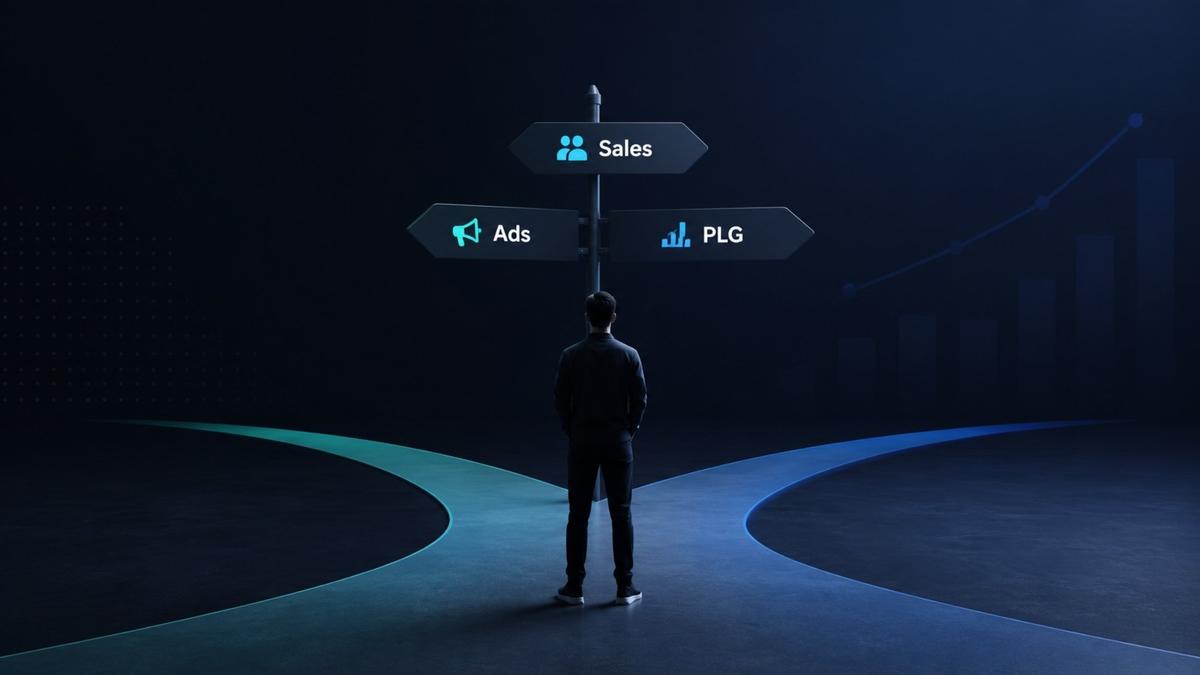
PLG vs Sales-Led: A Simple Decision Matrix
The rise of Product-Led Growth (PLG) has convinced many founders that every SaaS company should offer free trials, freemium plans, and self-service onboarding.
That isn’t always true.
The best go-to-market strategy depends heavily on product complexity and deal size.
Founder-Led Sales Works Best When:
- The problem is complex
- Buyers need education
- Pricing is high
- Sales cycles require trust
- Product-market fit is still emerging
Product-Led Growth Works Best When:
- The product delivers value quickly
- Users can onboard independently
- Pricing is relatively low
- Adoption spreads organically
- Usage creates expansion opportunities
Paid Acquisition Works Best When:
- Messaging is validated
- Conversion rates are predictable
- Unit economics are understood
- Customer lifetime value supports scaling
Many successful SaaS businesses use all three approaches eventually.
The mistake is trying to implement them simultaneously before validating the fundamentals.
Signal-Based Prospecting Beats Posting Into The Void
Content can support founder-led sales.
But content alone rarely creates momentum.
The strongest founders use content as a conversation starter, not a replacement for outreach.
Instead of broadcasting endlessly, look for buying signals.
Examples include:
- Hiring announcements
- New funding rounds
- Technology migrations
- Executive changes
- Public complaints about existing solutions
- Industry regulation changes
These signals create natural reasons to start conversations.
A founder reaching out with relevant context will usually outperform a founder publishing generic content and hoping prospects engage.
Visibility matters.
Relevance matters more.
Build the Minimum GTM Stack Before Hiring Sales
Many founders hire salespeople too early.
The problem isn’t the salesperson.
The problem is the lack of a system.
Before making your first sales hire, establish:
Clear Positioning
Can you explain your value proposition in one sentence?
Defined ICP
Do you know exactly who buys?
Repeatable Messaging
Can multiple prospects consistently understand the problem you solve?
Basic CRM
Track conversations, pipeline stages, and outcomes.
Documented Process
Create repeatable steps from outreach to closed business.
Only after these elements exist should you focus on scaling through additional headcount.
The founder’s job is to discover the process.
The salesperson’s job is to execute the process.
What Operator-Built Companies Do Differently
One pattern appears repeatedly among successful SaaS companies.
They spend less time chasing tactics and more time understanding customers.
The strongest operators don’t ask:
“How do I generate leads?”
They ask:
“Why would someone buy this today?”
That shift changes everything.
Instead of obsessing over channels, they focus on conversations.
Instead of optimizing ad campaigns, they optimize understanding.
Instead of hiring sales teams immediately, they learn the sales process themselves.
At All Great Things, we’ve seen this repeatedly while helping companies build go-to-market systems. The businesses that achieve traction fastest are usually the ones where founders remain closest to customer conversations early on.
The result is better messaging, stronger positioning, and a foundation that scales more effectively when marketing investments increase.
See how this principle applies in our CloudX case study and the GTM systems we help build for growing companies.
Founder-Led Sales FAQ
What is founder-led sales?
Founder-led sales is when founders personally drive prospecting, customer conversations, demos, and early revenue generation to validate product-market fit and build a repeatable sales process.
Is founder-led sales just posting on LinkedIn?
No. LinkedIn content can support awareness, but founder-led sales primarily involves direct customer conversations, outreach, demos, and closing deals.
How do SaaS founders get their first customers?
Most early SaaS companies acquire initial customers through their network, referrals, design partners, customer interviews, and targeted outbound outreach.
Should startups run paid ads before product-market fit?
Usually no. Ads work best after messaging, positioning, and customer profiles are validated. Early-stage founders typically learn more through direct sales conversations.
Is product-led growth better than founder-led sales?
Neither approach is universally better. Product-led growth works well for simple, self-service products. Founder-led sales works well for complex solutions that require education and trust-building.
Final Thoughts
The first version of your go-to-market strategy shouldn’t be automated.
It shouldn’t be delegated.
And it definitely shouldn’t depend on posting every day hoping buyers show up.
Founder-led sales is about getting close enough to customers that you can understand exactly why they buy.
Once you know that, marketing becomes easier.
Ads become more effective.
Product-led growth becomes more predictable.
And scaling becomes much less expensive.
Before you spend money on growth, spend time talking to customers.
That’s still where the best SaaS companies start.