Cold Email Is Not Dead, Lazy List Building Is: What Actually Matters in 2026
Every six months someone declares cold email dead.
The reality is much less dramatic.
Cold email still works. What has changed is the margin for error.
Five years ago you could scrape a list, buy a domain, blast 5,000 contacts, and stumble into enough meetings to call it successful. Today that same approach gets your domains burned, your emails filtered into spam, and your sales team wondering why nobody is responding.
The biggest mistake I see isn’t bad copy.
It’s bad infrastructure.
It’s lazy list building.
It’s treating AI-generated personalization as a substitute for understanding who you’re actually targeting.
This article is a follow-up to my previous post, The Cold Email Trap: Why It Fails More Than It Works, where I discussed why many outbound programs disappoint. This time, I want to focus on the operational side of outbound and explain what actually matters in 2026.
Deliverability vs. Personalization: What the Data Says in 2026
Most outbound software companies want you focused on personalization.
Why?
Because it’s easy to demo.
Showing a prospect an AI-generated first line feels impressive.
Showing them SPF records, domain reputation, inbox placement rates, and segmentation strategy does not.
But the reality is simple:
If your email never reaches the inbox, personalization doesn’t matter.
I’ve reviewed dozens of outbound programs where teams spent hours creating personalized opening lines while simultaneously:
- Sending from poorly configured domains
- Ignoring DMARC policies
- Uploading stale contact lists
- Targeting broad audiences
- Burning through domain reputation
Meanwhile, teams with average copy but excellent deliverability often outperform them.
What Actually Drives Cold Email Performance
When we audit outbound programs, the biggest performance drivers tend to rank in roughly this order:
- Deliverability — If emails aren’t reaching inboxes, nothing else matters.
- List Quality — Clean, verified data prevents bounces and protects domain reputation.
- Segmentation — Relevant messaging to the right audience consistently beats broad campaigns.
- Offer Relevance — Prospects respond when the problem and solution align with their priorities.
- Copywriting — Good messaging helps, but it can’t overcome poor targeting or deliverability issues.
- AI Personalization — Useful in some situations, but often overrated compared to the fundamentals above.
Most outbound teams spend their time optimizing the bottom of this list while ignoring the factors that have the greatest impact on results.
The Minimum Deliverability Stack Every Company Needs
Before you send a single campaign, you need a foundation.
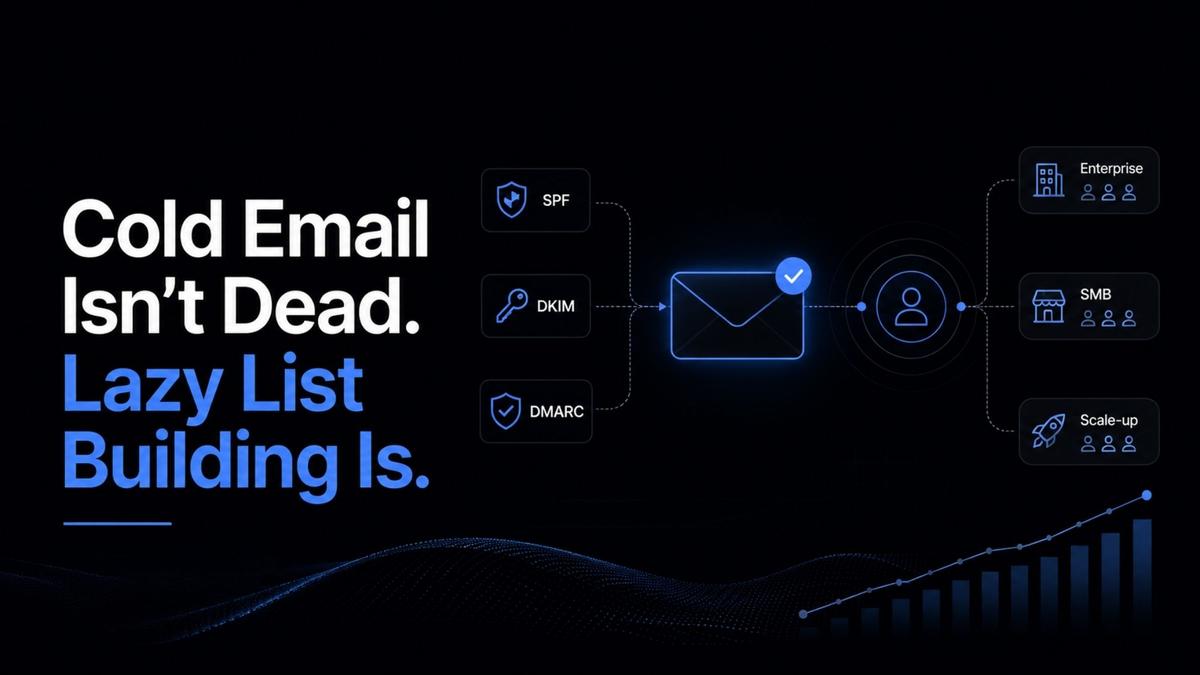
SPF
Sender Policy Framework verifies which servers are authorized to send email on behalf of your domain.
Without SPF, mailbox providers immediately become suspicious.
DKIM
DomainKeys Identified Mail validates that your message hasn’t been modified during delivery.
Think of it as a digital signature.
DMARC
DMARC ties SPF and DKIM together while providing enforcement policies.
If you’re not running DMARC in 2026, you’re already behind.
Domain Warming
Even a perfectly configured domain cannot immediately send thousands of emails.
Volume should be increased gradually over time.
Mailbox providers evaluate:
- Sending consistency
- Engagement rates
- Bounce rates
- Complaint rates
- Domain age
The goal is to build trust.
Not to maximize volume.
Inbox Monitoring
Many teams track opens and clicks.
Few monitor actual inbox placement.
There’s a difference.
An email platform might report delivery while Gmail quietly places your message into Promotions or Spam.
Those are very different outcomes.
List Building That Won’t Torch Your Domain Reputation
Most cold email problems begin long before the first email is sent.
They begin with the list.
The internet is flooded with “10,000 contacts for $99” providers.
That’s not a growth strategy.
That’s a reputation destruction strategy.
Strong list building starts with:
Clear ICP Definition
Before building a list, define:
- Industry
- Company size
- Geography
- Revenue range
- Technology stack
- Growth stage
- Decision maker
The narrower the ICP, the stronger the campaign.
Verification Before Sending
Every contact should be verified.
Hard bounces damage sender reputation quickly.
A list with a 10% bounce rate can destroy an otherwise healthy outbound program.
Continuous Refreshing
People change jobs.
Companies get acquired.
Email addresses become inactive.
Lists are assets that require maintenance.
Treating them as static databases creates problems.
Segmentation Beats Generic AI Intros
This is the most misunderstood part of outbound.
Many teams believe personalization means:
“Hey Sarah, I saw your recent LinkedIn post.”
That isn’t segmentation.
That’s decoration.
Segmentation means understanding why different groups should receive different messaging.
For example:
A VP of Sales at a 50-person SaaS company has different priorities than a CRO at a 5,000-person enterprise.
The same email should not go to both.
Strong segmentation can be built around:
Industry
Healthcare buyers care about different problems than manufacturing buyers.
Company Size
Small businesses optimize for speed.
Large enterprises optimize for risk reduction.
Role
A CEO and a Director of Operations evaluate opportunities differently.
Technology Stack
Your messaging changes dramatically depending on the tools someone already uses.
One segmented campaign often outperforms dozens of heavily personalized campaigns.
Why?
Because relevance beats cleverness.
Every time.
The Infrastructure Audit Checklist Before You Scale Outbound
Before increasing volume, answer these questions:
Domain Health
- SPF configured?
- DKIM configured?
- DMARC configured?
- Sending domains warmed?
- Multiple sending domains available?
Data Quality
- Contacts verified?
- Bounce rate below 3%?
- ICP clearly defined?
- Duplicate records removed?
Segmentation
- Industry segments created?
- Company size segments created?
- Persona-specific messaging built?
Campaign Metrics
- Inbox placement monitored?
- Reply rates tracked?
- Domain reputation monitored?
- Positive engagement measured?
If any of these are missing, scaling volume will likely make performance worse, not better.
When You Should Fix Deliverability Instead of Rewriting Copy
One of the biggest mistakes companies make is assuming low response rates are always a messaging problem.
Sometimes they are.
Often they aren’t.
Fix Deliverability First If:
- Open rates collapse suddenly
- Bounce rates increase
- Domains show reputation issues
- Campaigns stop generating responses entirely
Fix Messaging First If:
- Deliverability is healthy
- Open rates are strong
- Replies are weak
- Positive engagement is low
Too many teams rewrite email copy every week while ignoring infrastructure issues that are quietly preventing emails from reaching prospects in the first place.
The Real Lesson for 2026
The cold email conversation has become distracted.
Everyone wants to talk about AI SDRs.
Everyone wants to debate personalization.
Everyone wants a magic prompt.
Meanwhile, the highest-performing outbound teams continue doing the boring work:
- Building clean lists
- Maintaining domain health
- Verifying contacts
- Segmenting audiences
- Monitoring deliverability
- Creating relevant offers
The companies winning with cold email in 2026 are not necessarily using better AI.
They’re running better systems.
And systems beat hacks every time.
Frequently Asked Questions
Is cold email still effective in 2026?
Yes. Cold email remains effective when supported by strong deliverability, segmentation, and data quality practices.
What matters more: personalization or deliverability?
Deliverability. A perfectly personalized email has zero value if it never reaches the inbox.
What is the biggest reason cold email campaigns fail?
Poor list quality and weak deliverability infrastructure are the most common causes of failure.
How often should B2B contact lists be refreshed?
At minimum every quarter. High-growth industries may require monthly verification and updates.
Do AI-generated first lines improve cold email performance?
Sometimes, but the impact is usually smaller than improvements in deliverability, segmentation, and offer relevance.
Ready to Audit Your Outbound Infrastructure?
If your outbound campaigns aren’t generating meetings, the issue may not be your copy.
It may be your deliverability, segmentation, CRM workflows, or data quality.
Book an outbound and CRM automation review and let’s identify what’s actually limiting performance before you spend more money on tools.