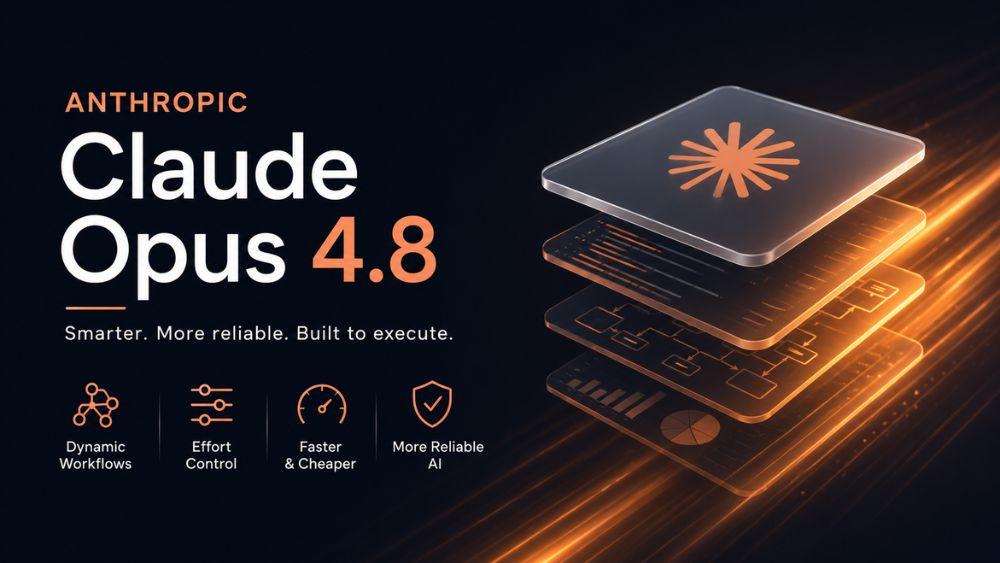
Anthropic just released Claude Opus 4.8, and while the company calls it a “modest but tangible improvement,” the reality is more significant for businesses using AI to accelerate execution.
This release is not just about benchmark scores. It’s about making AI systems more reliable collaborators for real-world work — especially for marketers, operators, developers, and SMB teams trying to move faster without sacrificing quality.
For companies focused on GTM strategy, content velocity, customer operations, and product execution, Claude Opus 4.8 introduces several upgrades that matter immediately.
Read the full release article here.
What Is Claude Opus 4.8?
Claude Opus 4.8 is the newest version of Anthropic’s flagship AI model. It builds on Opus 4.7 with improvements in:
- Coding performance
- Agentic workflows
- Reasoning quality
- Long-running task execution
- Reliability and honesty
- Multi-agent orchestration
Anthropic also launched several supporting features alongside the model:
- Dynamic workflows in Claude Code
- Effort controls for response depth
- Faster and cheaper “fast mode”
- Mid-task system instruction updates in the API
The biggest takeaway: Claude is evolving from a chatbot into a true AI operating layer for work.
Why This Release Matters for SMBs and GTM Teams
Most AI announcements focus on benchmark charts. What actually matters to businesses is whether the model helps teams execute better.
Claude Opus 4.8 appears designed specifically for operational reliability.
That matters because most SMBs and marketing teams don’t need AI to write a clever paragraph. They need AI that can:
- Build campaigns consistently
- Analyze performance accurately
- Execute workflows without hallucinating
- Assist developers reliably
- Handle long-running projects
- Improve decision-making
Anthropic focused heavily on reducing unsupported claims and improving judgment during complex tasks.
According to the company, Opus 4.8 is “around four times less likely” than Opus 4.7 to allow flaws in generated code to pass without flagging them.
That may sound technical, but the implication is huge:
AI systems are becoming more trustworthy collaborators.
Dynamic Workflows Could Change How Teams Operate
One of the most important announcements wasn’t the model itself — it was “Dynamic Workflows” inside Claude Code.
This feature allows Claude to coordinate hundreds of parallel subagents during a single task.
In practical terms, that means AI can now tackle:
- Large-scale code migrations
- Massive content audits
- Multi-page SEO optimization
- Complex research workflows
- GTM asset generation
- Enterprise-scale operational tasks
Anthropic says Claude can now work across “hundreds of thousands of lines of code from kickoff to merge.”
For growth teams, this points toward a future where AI doesn’t just assist individuals — it manages execution layers across departments.
Imagine:
- Auditing an entire content library
- Rewriting messaging by ICP
- Creating SEO updates at scale
- Generating sales enablement assets
- Running market research workflows
- Updating CRM documentation automatically
This is where AI shifts from productivity tool to execution infrastructure.
Effort Control Is More Important Than It Sounds
Another underrated feature is “effort control.”
Users can now choose how deeply Claude thinks before responding.
Lower effort:
- Faster responses
- Lower token usage
- Better for lightweight tasks
Higher effort:
- Better reasoning
- Deeper analysis
- More comprehensive outputs
This matters for businesses because not every workflow needs maximum intelligence.
For example:
Low Effort Use Cases
- Email drafts
- Social captions
- Quick summaries
- CRM updates
High Effort Use Cases
- GTM strategy planning
- Competitive analysis
- Technical architecture
- Long-form content creation
- Forecasting and research
This gives teams more control over cost, speed, and quality tradeoffs.
The Real Story: AI Reliability Is Becoming the Competitive Edge
The most interesting part of the release isn’t raw intelligence.
It’s reliability.
Anthropic emphasized honesty, uncertainty awareness, and reduced deceptive behavior throughout the announcement.
That may sound subtle, but it addresses one of the biggest enterprise concerns with AI adoption:
Can the system be trusted?
Businesses increasingly need AI systems that:
- Admit uncertainty
- Flag weak assumptions
- Avoid fabricated outputs
- Stay aligned with goals
- Operate safely at scale
Opus 4.8 appears optimized for exactly that.
For SMBs, this is especially valuable because smaller teams often lack the oversight layers that large enterprises have.
Reliable AI means:
- Fewer costly mistakes
- Better automation confidence
- Faster execution cycles
- More scalable operations
What This Means for Marketers
Marketing teams are entering a new phase of AI adoption.
The first phase was content generation.
The second phase is workflow orchestration.
Claude Opus 4.8 is built for the second phase.
The opportunity is no longer just “write faster.”
It’s:
- Build better systems
- Execute campaigns more intelligently
- Coordinate workflows automatically
- Improve operational leverage
Teams that embrace AI orchestration early will likely outperform competitors still treating AI as a simple writing assistant.
Final Thoughts
Claude Opus 4.8 may not be a dramatic leap in public perception, but it signals something more important:
AI systems are becoming dependable operational collaborators.
Anthropic is clearly positioning Claude as infrastructure for knowledge work, development workflows, and business execution.
For SMBs, marketers, and growth-focused teams, that opens the door to:
- Faster GTM execution
- Leaner operations
- Smarter automation
- More scalable decision-making
The companies that win with AI over the next 24 months likely won’t be the ones using the flashiest models.
They’ll be the ones building the best workflows around them.
And Claude Opus 4.8 looks increasingly built for exactly that future.